YOUR RAZOR BLADE IS CUTTING BELOW YOUR SKIN. AND THAT'S WHY YOU GET BUMPS.
Think about what a razor actually does. That sharp blade doesn't just glide across the surface, it angles into your skin and cuts the hair below the surface.
The sharp tip of that cut hair curls back down, trying to grow through the skin it came from, like a fishhook buried under the surface.

YOUR BODY'S DEFENSE SYSTEM ATTACKS YOUR OWN HAIR
Your body's immune system sees this curled hair as an invade, something foreign trying to pierce through from underneath. It sends white blood cells to fight it. The area swells. Red. Irritated. Bumpy. Your barber calls this "sensitive skin." Your dermatologist knows it has a name: pseudo-folliculitis barbae, or PFB. But the real name doesn't matter. What matters is this: it's not your skin type. It's not a weakness. It's not something you're born with. It's physics. It's the blade angle.
Your barber tells you to use special oils, creams, and techniques. He tells you that bumps are just part of your genetics. He's wrong on both counts. He's wrong because he's not looking at the root cause. He's looking at the symptom and treating the symptom while the root cause keeps happening every single time you shave. You can't out-cream a blade that cuts below the skin. You can't out-technique a physics problem. You have to fix the angle.
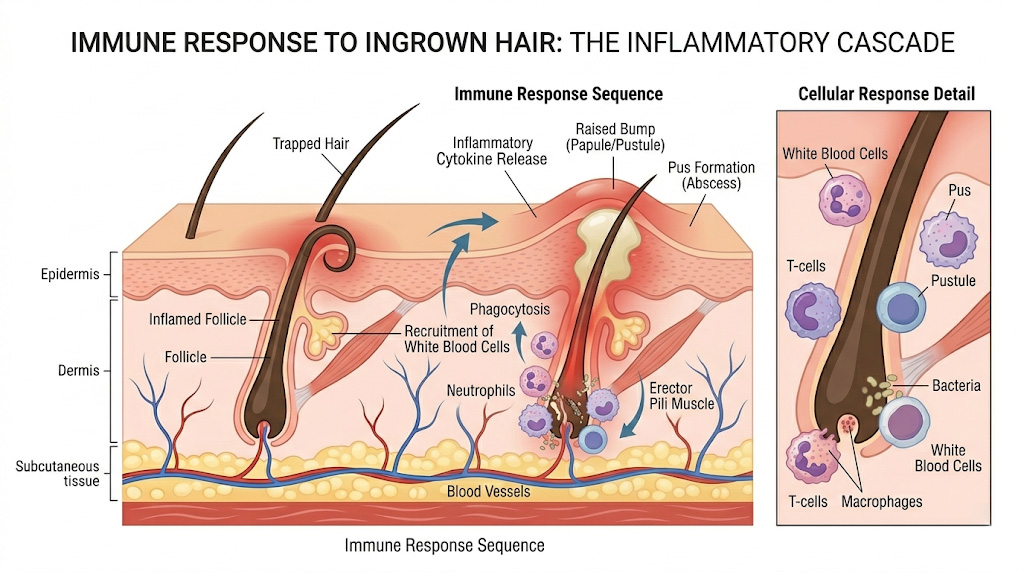
WHAT'S HAPPENING UNDER YOUR SKIN RIGHT NOW
When a traditional razor cuts your hair, it doesn't cut at the skin level. It cuts below the surface. The blade presses down into the follicle, past the skin, and cuts the hair shaft as low as possible, sometimes below the skin line. This creates a sharp, angled tip on the cut hair. The hair, naturally, wants to grow out and away from the follicle. But because it's been cut at such an angle, and because it's being pushed by the follicle as it grows, that sharp tip curves back. It curves back toward the skin. It curves back toward the same opening it grew out of. If it curves enough, it pierces back through the skin from the inside.
Your skin doesn't know this is your own hair. All it knows is that something sharp just pierced it from inside. The immune system responds. Inflammatory cells rush to the site. The area fills with fluid. The tissue swells. The swelling makes the bump visible. The inflammation makes it red. Sometimes it gets infected because bacteria love inflamed tissue. This is what a razor bump actually is: an immune response to your own hair trying to grow through your skin like a foreign invader.
And this happens because of the blade angle.
The angle matters more than anything else. A razor blade that sits perpendicular to your skin, cutting right at the surface level, not below it, doesn't create that sharp, curling tip. It creates a blunt edge. A hair with a blunt edge, even as it grows back and pushes through the follicle, can't pierce through skin the same way. It's not sharp enough. The growth is natural. No inflammation. No immune response. No bumps.
The problem is: most shavers can't maintain that angle. Razors press down. Cartridge razors have multiple blades, each one pressing slightly deeper than the last. Safety razors have a fixed angle but can't follow the contours of your neck and jaw. And the shaving motion itself—moving the razor back and forth, going over the same spot multiple times to get a closer shave—means you're cutting deeper on the second pass, third pass, and beyond. You're creating different blade angles across different areas of your face in a single shave.
Most men accept this as normal. Most men then accept bumps as normal, too. It's not normal. It's just what everyone's doing, so it feels normal.
WHY EVERY BLADE TYPE FAILS (EXCEPT ONE)
Let's talk about what you've probably already tried.
Cartridge Razors (Gillette, Schick, and everyone else)
Three blades. That's the whole selling point, right? More blades, closer shave. Here's what that actually means: the first blade cuts the hair at one depth. The second blade cuts it deeper. The third blade cuts it even deeper still. You're guaranteed to be cutting below the skin surface by the time you reach that third blade. Each blade is a separate opportunity to create an ingrown hair. And they're stacked together, so one shaving motion hits all three. Three chances to go too deep. Three different blade angles on your neck from a single pass. Why does the industry do this? Because a closer shave sells razors. Because men equate a close shave with a quality shave. They don't think about the mechanism. They just feel the result, and feel smooth. But smooth at what cost?
Safety Razors (Bevel, Supply, and the hipster shops)
One blade is better than three. That's genuine progress. A single blade means one angle, one depth. You're not compounding the cutting below the skin. However, here's where the safety razor falls short: it has a fixed guard and a fixed angle. Your face isn't flat. Your neck isn't flat. Your jawline has curves. Your skin rises and falls across your cheeks, chin and throat. A flat guard can't follow those contours. It hovers over some areas and presses into others. Where it hovers, you miss hair. So you go over it again. Second pass on the same spot with the same blade. That's when you cut deeper. That's when the blade digs in. And the fixed angle means it's the same angle as the first pass, you're not changing depth, but you're hitting follicles twice with the same blade direction. Ingrown hairs love that. Red bumps love that. Plus, you can't get a clean line. If you want to line up your beard or create edges, the safety razor's flat guard means you're doing that with the same blade angle as the rest of the shave. Bumps along the edge are standard.
Foil Shavers (the straight bar guys)
A foil shaver has tiny holes in a thin metal foil. Hair enters the holes, gets cut below the foil, and falls away. The theory is: the foil is thin, so you're cutting close to the skin but not below it. Reality is messier. Your hair doesn't grow straight up and down. It grows in multiple directions—some at angles, some curled, some twisted. A flat foil is perpendicular to the skin at exactly one angle. Everywhere else on your face, you're either cutting too shallow (missing stubble) or too deep (cutting below skin). You rotate the shaver, change angles, and go back over spots. Each angle change is another cut at another depth. By the time you're done, you've hit every area of your face at multiple depths. Some hairs were cut bluntly. Some were cut sharply. Guess which ones curl back and pierce the skin. Foil shavers work okay for straight, fine hair. If your hair has any texture, any curl, any variation—which most men do—a foil can't follow that variation fast enough.
Barber Clippers (what your barber uses on you)
Here's a truth nobody wants to say: your barber's clippers are probably dull. He's using the same blades on thirty heads a day. That's thirty different hair types, thirty different shaving directions, and thirty opportunities for the blades to wear down. Dull blades don't cut cleanly. They pull. They tear. They create micro-tears in the hair shaft and in the skin. Micro-tears are inflammation waiting to happen. And the pulling? That yanks the hair as it cuts, stretching the follicle, creating tension below the skin. When that hair grows back, it's growing under tension. That tension pushes it back toward the skin. Guess what happens next. Your barber is a professional. He has skills. His hand is steady. But he's fighting dull blades and a tool that was designed for speed, not precision. And you're walking out of his chair with bumps two days later.
Rotary Shavers (the real solution)
A rotary shaver has six independent heads. Not one flat surface. Six rotating heads, each one moving independently. Each head is a small circle with a curved surface. As you move the shaver across your face, each head follows the contours of your skin. They don't float. They don't press in uniformly. They contour. They conform. They adjust to every curve and angle your face presents. Your jaw. Your neck. Your cheeks. Your chin. Your upper lip. Each head is independently floating and rotating, so each head can follow a different contour at a different angle simultaneously. Here's the critical part: each head has a cutting mechanism that removes the hair at the skin level. Not below it. At it. The blade sits against a foil or a grid, and that foil or grid is designed to cut hair that's been pulled slightly up and away from the follicle by the rotating motion. The cut happens right at the skin surface. The hair gets a clean, blunt edge. No sharp tip. No curling mechanism. Hair grows back naturally, blunt-edged, and there's no mechanism for it to pierce back through the skin.
The shaving principle is physics. The engineering principle is to follow the contours. And the result is: no bumps.
HOW 4D CONTOUR-FLOAT CHANGES EVERYTHING
The 5-in-1 grooming kit uses a system called 4D Contour-Float. Let's break down what that means, because the engineering here is what solves the problem.
The 4D part refers to how the heads move. Traditional shavers have heads that rotate in one or two directions. This one has five heads that rotate independently, AND the entire head unit floats on a suspension system. So each head is rotating (that's two degrees of freedom—forward-back and side-to-side spinning). But the entire unit is also moving up and down, forward and back, and side to side independently as it follows your face's contours (that's four dimensions of movement total). It's not hard-mounted to the shaver body. It's floating. It's responsive.
Why does this matter? Because your face is not a flat plane. Your jaw juts forward. Your neck curves back. Your cheeks have height and shadow. Your chin has a point. A shaver with a fixed head angles into some parts of your face and hovers off others. A floating head system adapts. Each of the six rotating heads can be at a different angle relative to the skin at the same moment, because they're not locked together. They're independent. They're floating.
The second key principle is cutting at the skin level. The 4D system uses a precision-engineered foil that sits just above the skin. The rotating heads pull the hair slightly up and away from the follicle—that's the mechanism that gets the hair to come up and out of the follicle. Then the blade beneath the foil cuts it, right at skin level. The design prevents the blade from pressing down below the surface. The foil acts as a guard that's specifically calibrated to the cutting blade's depth.
This is the same engineering principle used in shavers that cost ₦200,000 and up. Braun Series 9. Panasonic Arc Series. They all use this principle because it works.
It works across all hair types, all skin types, all ethnicities, and all curl patterns.
The 5-in-1 grooming kit uses the same principle. Same physics. Same engineering. Different price tag. Braun charges ₦200,000 for a premium rotary shaver. 5-in-1 grooming kit charges ₦39,000 for the entire 5-in-1 kit. Same cutting mechanism. Same contour-float technology. Same result. Different cost structure because of different manufacturing, different distribution, different market.

WHAT EACH TOOL ACTUALLY SOLVES
The kit comes with five tools. Let me tell you what each one does, and why it matters.
1. THE ROTARY SHAVER
This is the core tool. This solves the bump problem. The 4D Contour-Float with five independent floating heads cuts at skin level and follows your face's contours. This is what prevents pseudo-folliculitis barbae. This is what ends bumps. You use this for your primary shave—face, neck, all the areas where you grow full facial hair. Daily use, two-to-three minutes, and you're done. The bumps stop because the blade angle issue is solved. Battery life is 60+ minutes per charge, which is roughly 40 shaves before you need to plug in. USB rechargeable, so any charger works. IPX7 waterproof, which means you can use it wet or dry. Wet shaving actually gives you a slightly closer shave because the water and the pre-shave work together to lift the hair, but dry shaving works just as well.
2. THE PRECISION TRIMMER
This solves a different problem: barber dependency. Most men go to a barber every week or two specifically for lines. For edges. For the sharp lineup that makes you look intentional and groomed. The precision trimmer does that for you. It's a small, focused blade designed for detail work. You can line up your beard. Create sharp edges on your cheeks. Clean up your neckline. Control the shape of your sideburns and moustache. No more walking into a barber for a line-up. No more paying every week just to keep your edges clean. This sounds like a convenience feature. It's not. It's independence. It's knowing that if you want to adjust your look or touch up an edge, you can do it immediately instead of waiting for a barber appointment and paying for the full service.
3. THE NOSE AND EAR TRIMMER
This one is about hygiene and dignity. You're not sharing tools with a barber. You're not having someone else handle your nose and ear hair. You have a dedicated tool, sterile, in your home, available anytime. It's also a tool that actually works, with a rotating head designed to catch and cut hair in those curved, difficult areas. You're getting clean, close, safe results without risk of nicks or irritation in sensitive areas. This tool saves you from a barber visit or, let's be honest, it keeps you from letting yourself go when you're busy or travelling.
4. THE SIDEBURN TRIMMER
Sideburns are detail work. They need to be straight. They need to be even. They need to be at the right length relative to your beard. The main rotary shaver gets the general shave, but sideburns need precision. The sideburn trimmer gives you that. It's a small, controlled blade specifically designed for the curved surface of the sideburn area. You can trim to the exact length you want, create a clean line where the sideburn meets your cheek, and keep them perfectly even. This is the difference between looking intentional and looking like you don't care. Again, this is independence. You don't need a barber to fix your sideburns. You have a tool designed for exactly this job.
5. THE FACIAL BRUSH
This is the tool that prevents bumps from happening in the first place, before you even pick up the shaver. The brush exfoliates your skin and lifts the hair away from your face. Dead skin cells? Gone. Hair that's curled or tangled? Lifted and straightened. You're preparing the canvas for a clean, at-skin-level cut. The brush reduces friction during shaving, which means less irritation. It also helps lift hair that might otherwise be stubborn. Use this before your shave every time, and you're removing one of the root causes of bumps: hair that's pressed down into the skin instead of standing up to be cut cleanly. Think of this as the difference between cleaning your work surface before you work and just working on a dirty surface. One leads to clean results. One leads to complications.
WHY ₦39,000 ONE TIME BEATS WEEKLY BARBER VISITS FOREVER
Let's talk money, because this matters. If you're getting a full shave from a barber once a week, that's roughly ₦2,000 to ₦3,000 per visit. Let's say ₦2,500 per week, conservatively. That's ₦130,000 per year. Over five years, that's ₦650,000. Over ten years, that's ₦1,300,000.
The 5-in-1 grooming kit is ₦39,000. One time. That's it.
You break even after 17 weeks. Less than four months. After that, you're not spending money on barber visits. You're not walking out of shops frustrated because your barber was busy, or the quality was inconsistent, or you got bumps anyway. You're shaving at home, in your bathroom, with tools that you control, on your schedule.
Even if you cut your barber visits in half—meaning you still go in for the detail work you trust, but you handle the main shave yourself—you're saving ₦65,000 per year. The kit pays for itself in less than a month. Then it's just savings.
And this math doesn't include the bump problem you're solving. No bumps means no money spent on creams, no inflammation, no frustration.
It's not just financial. It's freedom.
REAL RESULTS FROM MEN WHO WERE SKEPTICAL
The science is solid. But here's what real men actually experienced.
70,000+ NIGERIAN MEN STOPPED PAYING THE BARBER TAX
Real reviews, real results
QUESTIONS YOU'RE ACTUALLY ASKING
"Will it work on my hair texture?"
Yes. The 4D Contour-Float system with five independent floating heads adapts to any hair texture. Straight hair, curly hair, coarse hair, fine hair, mixed curl patterns—the independent heads mean each one follows its own section of your face and adjusts to that hair's angle and texture in real time. This is the advantage of six independent heads versus one fixed blade or foil. Your hair texture variation is handled by having five different cutting surfaces that move independently. This technology was developed for this exact reason.
"How close is the shave compared to a blade?"
Extremely close. The foil sits right at skin level, and the rotating mechanism pulls hair up and away from the follicle before cutting. Most men report a shave that's within 12 hours of a cartridge razor shave, without any of the irritation. Because you're cutting at the skin level instead of below it, you're getting the shortest safe cut possible. Some men who used to shave with razors notice that their shave with this lasts slightly longer (meaning less stubble returns in the first few hours) because there's no irritation from pulling hair back into the skin.
"What about my lineup? Will the precision trimmer really replace the barber?"
Yes, absolutely. The precision trimmer is sharp and designed for detail work. Your line-up depends on two things: a sharp blade and steady hands. You have steady hands. The trimmer has a sharp blade. You can clean up your edges, straighten your fade line, clean your neck, and create the exact look you want. You might need to practice the first time or two to get angles right, but most men pick it up within a couple of uses. And you control the final result instead of hoping the barber has you in at the right angle.
"How long do the blades actually last?"
The shaver comes with replaceable foils, and the precision trimmer blade is replaceable too. Most men get 12-18 months of daily use before sharpness starts to noticeably decrease. At that point, you replace the foil or blade. Replacement parts cost far less than buying a new shaver. For the precision trimmer, a replacement blade is about ₦2,000-₦3,000. For the main shaver foil, it's about ₦5,000-₦7,000. Annual maintenance cost is maybe ₦10,000 max, assuming you replace the foil yearly and the trimmer blade once or twice. Still massively cheaper than weekly barber visits.
"Can I use it wet? How waterproof is it really?"
IPX7 waterproof means it's safe in water up to one meter for 30 minutes. In practical terms, you can use it in the shower, you can rinse it under running water, or you can fully submerge it briefly. You cannot leave it sitting in a bathtub or use it underwater for extended periods. Most men use it wet because the water helps lift hair and reduces friction. Some use it dry. Both work. Just dry it after wet use (dry it fully, not just shake it). The waterproofing means you don't have to worry about splashes or shower steam damaging it.
"What if it doesn't work for me? What if I still get bumps?"
We offer a replacement for all 5-in-1 grooming kit products. If you buy it, use it for 30 days, and it doesn't solve your bump problem, it can be replaced. No questions. This is because the company knows the physics works. The 4D Contour-Float technology, solving the blade angle problem, isn't theoretical. It's proven across multiple manufacturers at much higher price points. So if it doesn't work, there's something else going on with your specific situation (very rare skin condition, allergic reaction to the metal, etc.), and you should talk to a dermatologist. But the refund guarantee means you can try it without risk.
NOW YOU KNOW WHY BUMPS HAPPEN
Your razor blade cuts below your skin. That creates a sharp, curling hair tip. Your body sees it as an invader and attacks it. That's a bump. That's not genetics. That's not your skin type. That's physics. That's a blade angle problem.
Every shaving technology fails to solve this except one: rotary shavers with independent floating heads that cut at skin level. Hair Shave Nai uses this technology. Six independent floating heads. 4D Contour-Float. Cuts at skin level, never below.
Plus five tools that handle everything else: precision trimmer for your lines, nose/ear trimmer for hygiene, sideburn trimmer for detail, and facial brush for prep.
₦39,000. One time. That's less than 17 weeks of barber visits. Then it's just savings and independence and clean shaves without bumps.
Payment on Delivery. Free shipping. Replacement guaranteed, so you can try it without risk.
 BREAK FREE FROM BUMPS
₦80,000
ONE-TIME PRICE
₦39,000
You missed out!

 WARNING — PLEASE READ BEFORE ORDERING
1. DO NOT ORDER if you are not ready to receive your package within 3-5 business days.
2. DO NOT ORDER if you will not be available to pick up or receive delivery.
3. Make sure you have ₦39,000 ready before placing your order (pay on Delivery).
4. We WILL call you to confirm your order. Please pick up your phone.
5. Delivery is FREE nationwide.
P.S. You now understand the physics of why bumps happen. It's the blade angle. It's not your genetics. It's not your skin type. It's not a weakness. It's a problem with a proven engineering solution.
P.P.S. ₦39,000 one-time fixes what your barber has been charging you monthly to create. The break-even is four months. After that, you save ₦130,000+ every year.
P.P.P.S. Fix the blade angle. Get the kit. Move on. Stop treating bumps as normal.
ORDER NOW — CASH ON DELIVERY, FREE SHIPPING NATIONWIDE
✓ Same tech as ₦200k+ Braun · ✓ 30-day guarantee · ✓ five independent floating heads · ✓ Inspect first, pay after
This site is not a part of the Facebook website or Facebook Inc. Additionally, this site is NOT endorsed by Facebook in any way. FACEBOOK is a trademark of FACEBOOK, Inc.
This site is not a part of Google or Google LLC. Additionally, this site is NOT endorsed by Google in any way. Google is a trademark of Google LLC.